
5 REASONS WHY A PATIENT'S FAMILY LOOKING FOR SOMEONE TO BLAME WILL ALWAYS LAND ON THE NURSE
★★★★★
4.9 Stars — 11,000+ Verified Nurse Readers

1.
THERE ARE TWO KINDS OF NURSES WHEN A FAMILY STARTS ASKING QUESTIONS
Something goes wrong. Not because of anything you did — outcomes go bad in this job, and everyone on the unit knows it. But the family starts asking questions, and quietly, two kinds of nurses walk out of that week.
The first one isn't worried. And why would she be? Everyone saw how hard she worked. She was in that room more than anyone. If it ever came to it, surely someone would say so — the charge nurse, the family, the people who watched her stay late three nights running.
The second one knows something the first one doesn't. Nobody is going to be asked what they saw. Nobody gets called in to describe the nurse who caught the change first. When a family goes looking for an answer, what they're handed is a document — and a document is the only witness that shows up. Same nurse, same week, same care. Two completely different years ahead of them, decided by something neither of them was thinking about at the time.
I WAS THE FIRST ONE
Teresa K.

Verified Buyer
"I always figured everyone knew how hard I worked, so I'd be fine if anything ever happened. It never once occurred to me that nobody gets asked. That single idea rearranged how I think about my notes."

2.
"THEY LOVED ME. THEY'D NEVER DO THAT." IS THE MOST DANGEROUS THING TO BELIEVE
Here's the part that catches good nurses. It isn't about love, and it was never personal. The family that thanked you on Tuesday isn't a different family on Friday. They're the same people — they just lost someone, and grief doesn't accept "nobody's fault" as an answer. It needs a reason. That search doesn't start with malice. It just needs somewhere to land.
And it lands closest. The physician was in that room for six minutes. You were there for twelve hours. When a family reconstructs the worst days of their life, yours is the face in every frame. Being remembered and being findable turn out to be the same thing. The relationship you built — the extra time, the questions you answered, the hand you held — is exactly what puts your name in the file.
That's the trap in the comfort. The nurses who get blindsided are almost always the ones who thought the relationship was the protection. That the warmth would be remembered, that they'd get the benefit of the doubt from people who knew them. It doesn't work that way, and it never did. Being loved in the room has never once stopped a name from being written down after it.
IT WASN'T PERSONAL — THAT WAS THE SHOCK
Denise H.
Verified Buyer
"The family I got named by was one I'd been close with for weeks. I kept thinking there was a mistake. A colleague explained it to me plainly: they weren't angry at me, they just needed an answer. That reframe hurt, but it was the truth."
3.
THE SYSTEM DOESN'T REWARD BEING THERE. IT REWARDS BEING DOCUMENTED.
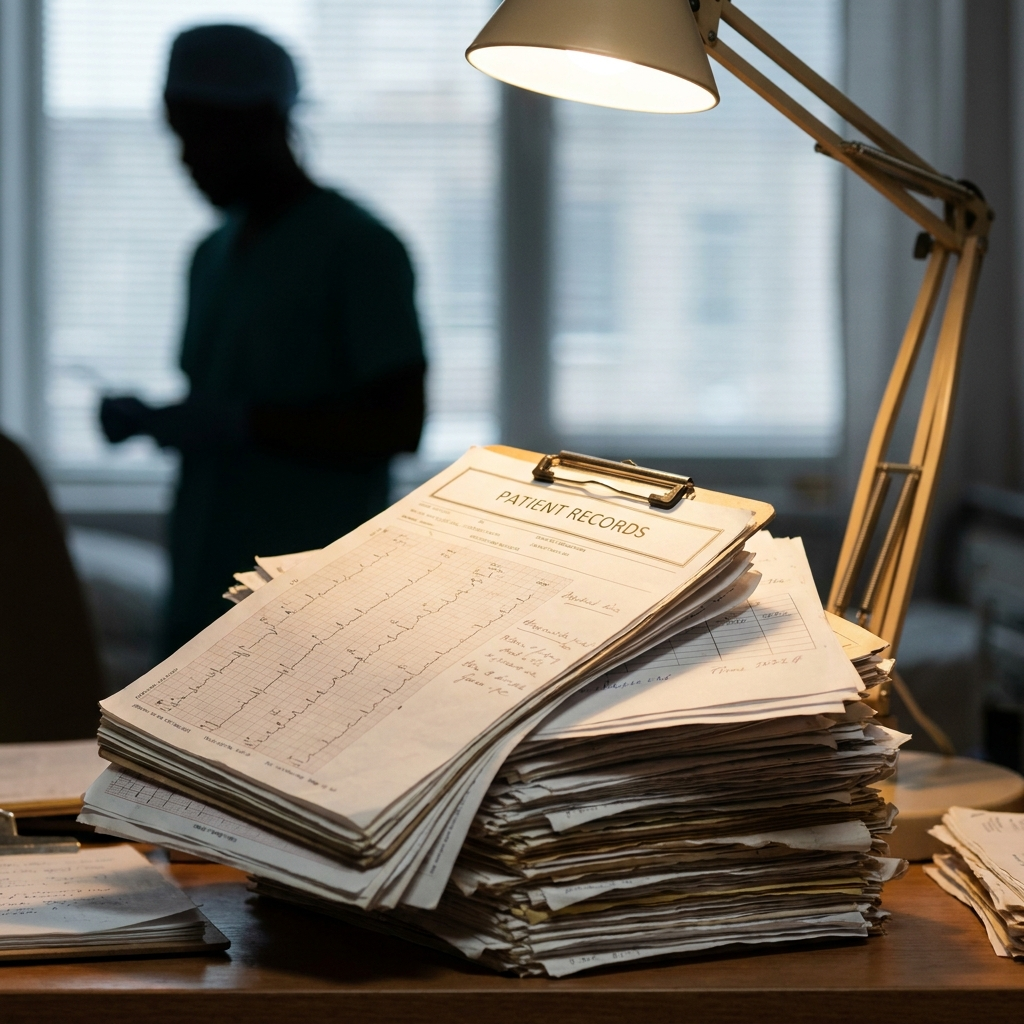
Here's where it turns. You can be the one who stayed, the one who noticed first, the one who advocated hardest — and still be the one who's named. Not because you were worse. Because your presence left no trace and someone else's did. The care happened in the room. It stayed in the room. What travels forward is a chart.
And this is the part that decides everything: a chart that records only tasks reads like a nurse who only did tasks. The reasoning that made you good — why you watched that patient closer, why you called when you did, what you were weighing at 3 a.m. — none of it is in there. So a stranger reading it two years later doesn't meet the nurse you were. They meet a blank, and a blank invites a question.
Fair has nothing to do with it. Provable is everything. That's the whole line between the two kinds of nurses, and it has almost nothing to do with skill or heart. The chart is the only version of you that shows up when you can't. It either carries your judgment forward or it leaves an opening. Most nurses were never taught the difference, because nobody teaches defensive documentation. One legal nurse consultant set out to change that.
FINALLY UNDERSTOOD THE REAL ISSUE
Priya S.
Verified Buyer
"I always believed being a good nurse was its own protection. This showed me the chart is what speaks for you, not your reputation and not the people who watched you work. It completely changed how I document. I wish I'd learned it years ago."
4.
THE NURSES WHO STAY PROTECTED STOPPED RELYING ON BEING REMEMBERED WELL
The reason it works when other resources don't: it's a way of reading your own notes, not a pile of tips. You learn to see one phrase the way a plaintiff's attorney will, then the next, and each fix quietly makes the one after it easier. You're never asked to chart more or stay later — just to write the same note a smarter way, so it stands on its own years from now.
A few of the first fixes:
Kill the phrase that hangs nurses — Swap "will continue to monitor" for a specific, documented action, so it can't be twisted into proof you saw a problem and did nothing.
Pair every quote with a fact — Follow a patient's words with an objective finding, so no lawyer can argue you wrote it to mock or dismiss them.
Prove you escalated — Document the call the moment you make it, so there's a record you notified the provider — not just your word two years later.
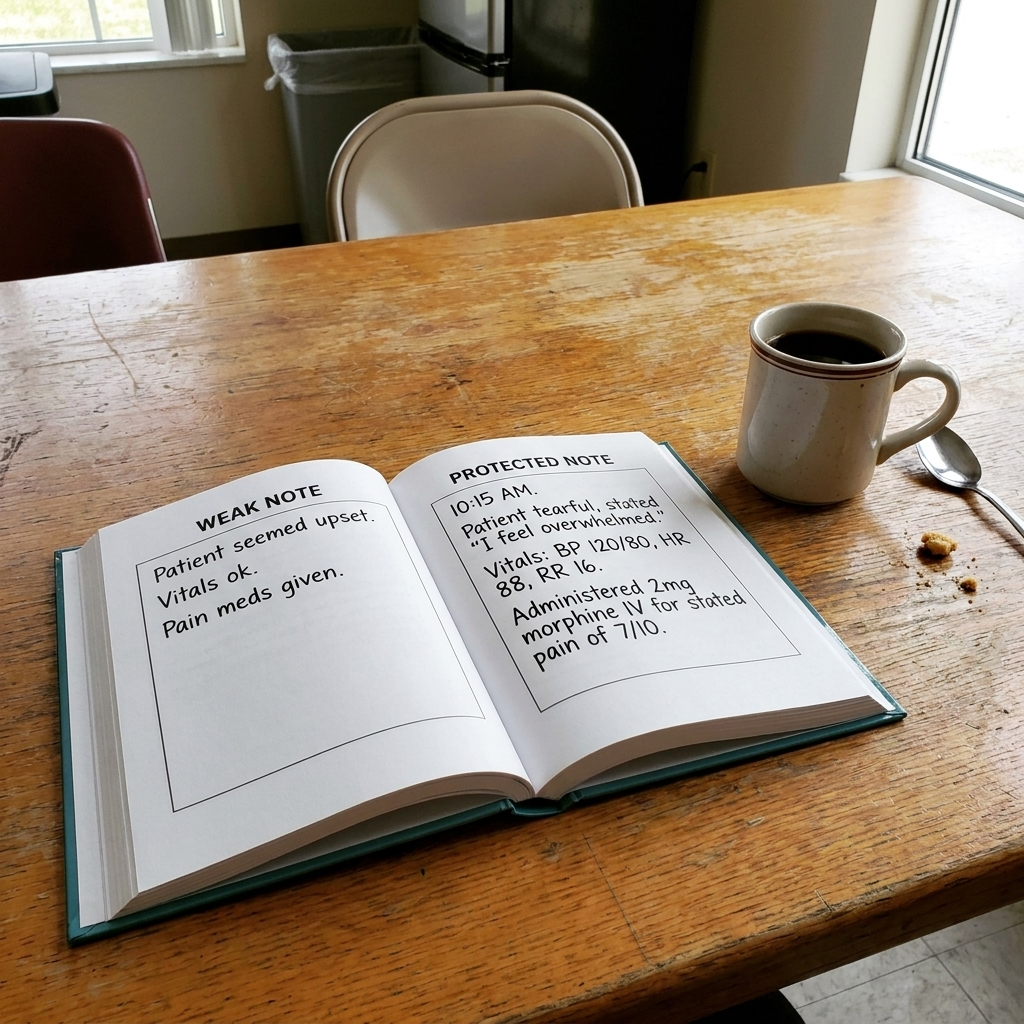
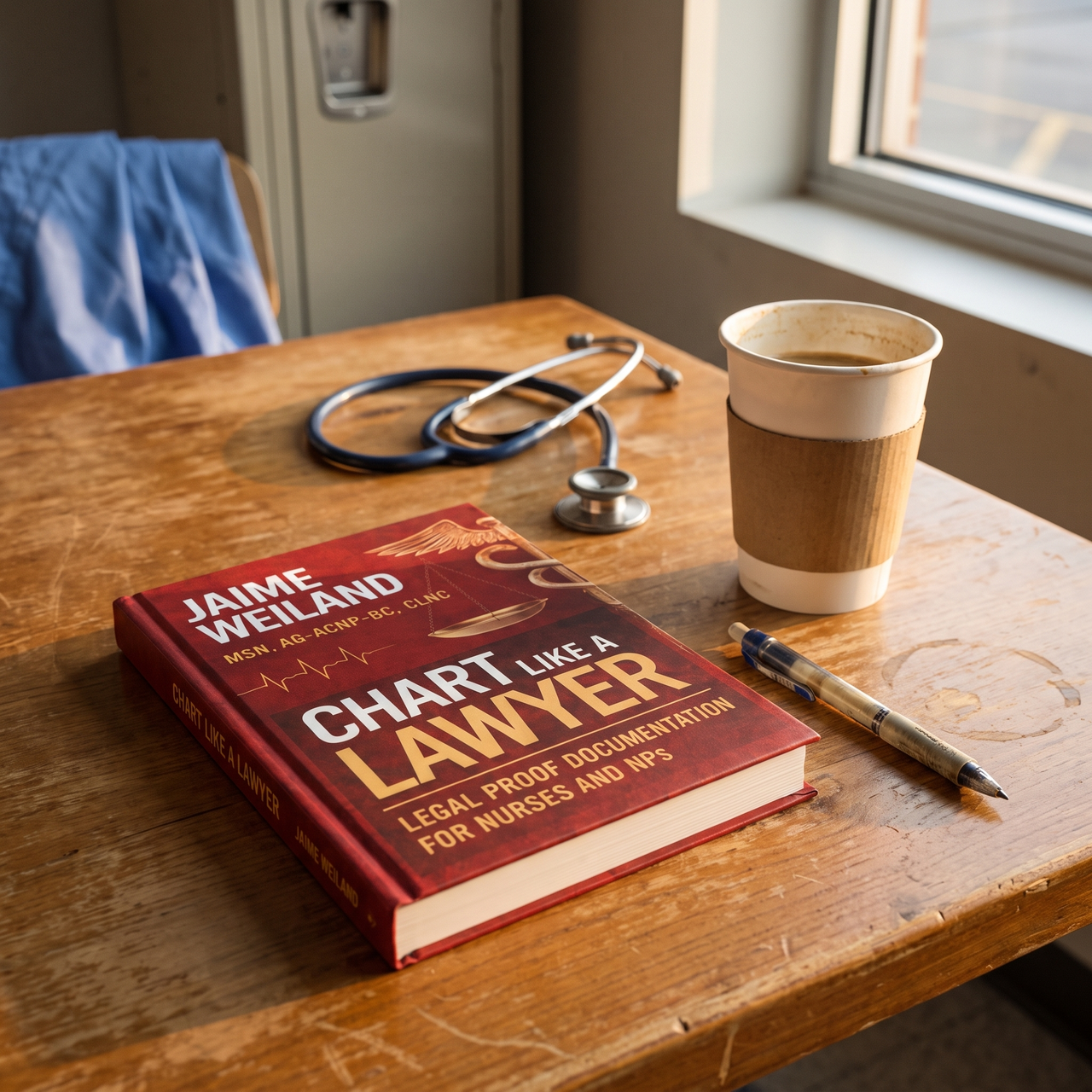
It was written by Jaime Weiland, a nurse practitioner who's lived your exact shift, and a legal nurse consultant whose job is reading charts the way the hospital's attorney reads them. It doesn't take time you don't have or details you can't recall. It works on any shift, at any ratio, because it's about how you write the note, not how much. Follow the examples — the weak note and the protected note, side by side — and you'll chart differently by your very next shift. And the whole book costs under forty dollars: less than one takeout dinner, with no course or subscription waiting at the end of it.
KNEW EXACTLY WHAT TO WRITE
Rebecca L.
Verified Buyer
"I expected another dry textbook. Instead it showed me the weak note next to the protected note, over and over. By my next shift I was already charting differently. The 'will continue to monitor' section alone was worth it."
5.
YOU ONLY NEED ONE SKILL TO CROSS OVER
Picture the second nurse. Something goes wrong, the questions start, and she isn't spinning. She can't stop grief from looking for an answer — nobody can. But she knows what's in her charts, and she knows they hold. Her reasoning is on the page. Her calls are timestamped. The stranger who reads it two years from now meets the nurse she actually was, in her own words, written long before anyone thought to ask.
That's what nurses tell us again and again. Veterans with thirty years in say they wish they'd had it at the start. New grads say they finally feel like they know what they're doing. One nurse was removed from a lawsuit completely — pulled out of it — because of how she'd charted. Her words: what I charted is what happened. That was the entire defense.
For less than the price of a takeout dinner, you get the one skill that moves you from the first nurse to the second — the one that protects the license you spent years and thousands of dollars to earn, and does it whether or not anyone speaks up for you. It's already sold out once because word spread so fast among nurses. And there's a guarantee: read it, and if it doesn't change how you chart, you're covered. The only real risk left is one more shift spent hoping you'll be remembered well. Tap below and grab your copy while it's in stock.
Karen M.
Verified Buyer
"I was named in a suit two years after caring for a patient I barely remembered. I pointed to my chart and repeated the same thing until they let me go. What I charted is what happened — and that's the only reason my name came off it. This book teaches you to chart exactly like that, before you ever need it."
THE HOSPITAL PROTECTS THE HOSPITAL. YOUR CHART PROTECTS YOU.
CHART LIKE A LAWYER
By Jaime Weiland — Legal-Proof Documentation for Nurses & NPs. Learn to chart so it protects you.
$59.99
Only $39.99




4.8 Stars — 10,000+ Verified Reviews