
5 REASONS WHY EVERY NOTE YOU WRITE FROM MEMORY IS A NOTE YOU'LL HAVE TO DEFEND
★★★★★
4.9 Stars — 11,000+ Verified Nurse Readers
1.
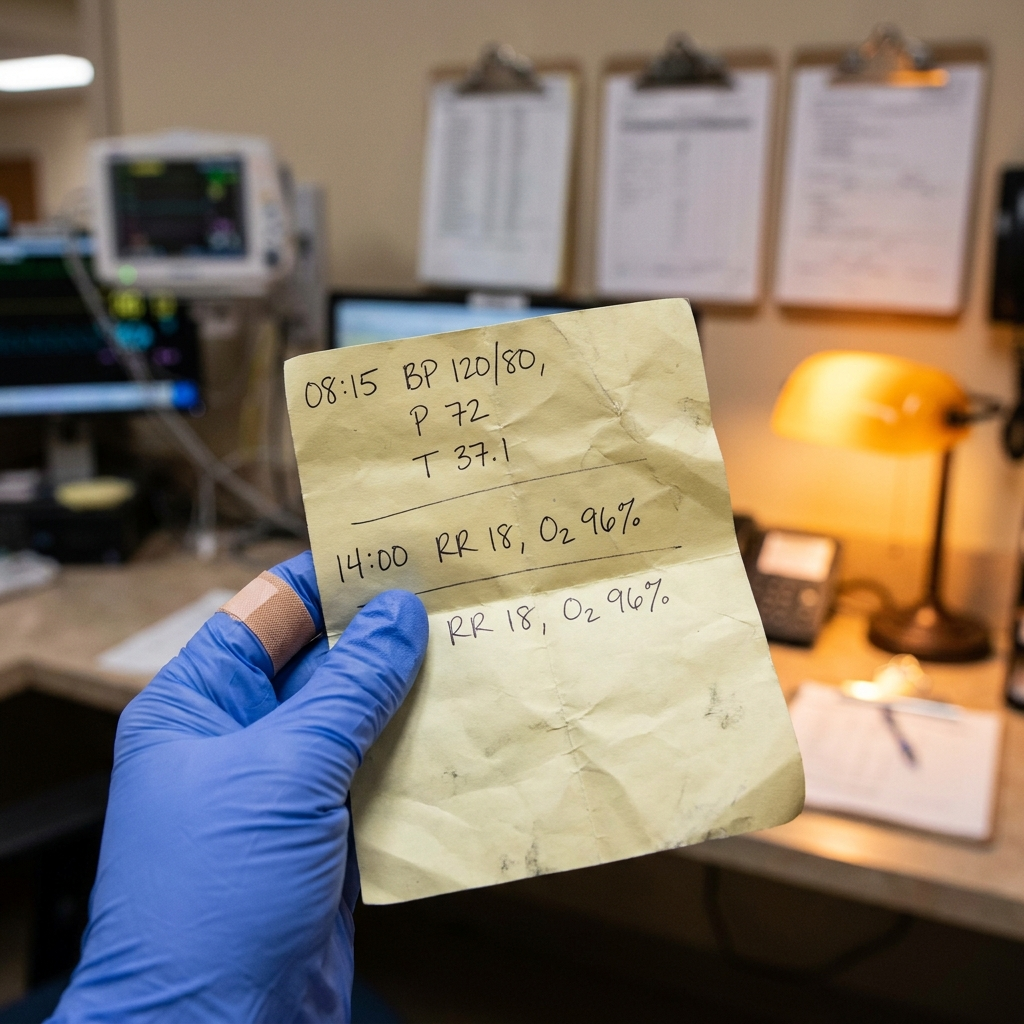
MEMORY STARTED DECAYING THE MOMENT YOU WALKED OUT OF THE ROOM
Not at the end of the shift. Immediately. The second you stepped into the hallway and the next thing started, the details began going soft — the exact time, the precise sequence, the words the patient actually used. That's not a flaw in you. That's how memory works in every human being who's ever lived.
So by the time you sit down at 7:40 with your scrap of paper, you're not recording what happened anymore. You're rebuilding it. And you rebuild it well — you're careful, you're honest, you get the important parts right. But the note is accurate the way a story is accurate: mostly, in the parts that mattered enough to survive the day.
Here's what nobody tells you about that gap. The record doesn't come with an asterisk explaining it was written from memory nine hours later by a nurse who hadn't sat down since 7 a.m. It just sits there, looking like a contemporaneous account of events. And two years from now, that's exactly how it'll be read — as if you wrote it standing at the bedside, with the clock in front of you. Every note you've ever reconstructed is being held to a standard it was never written under.
I NEVER THOUGHT OF IT THAT WAY
Teresa K.

Verified Buyer
"I chart from a piece of paper in my pocket at the end of every shift, like everyone I work with. I'd never once considered that the note gets read as if I wrote it in the moment. That single realization changed how I document."
2.
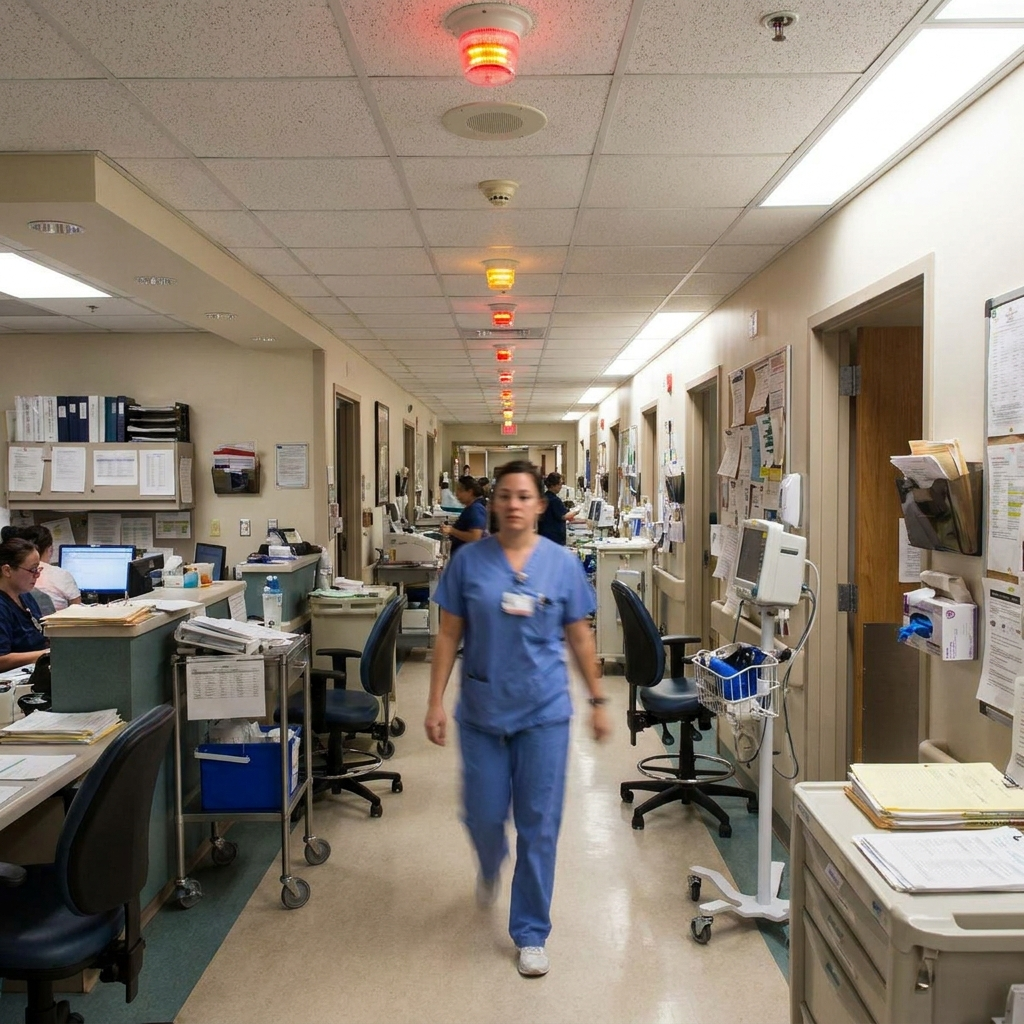
YOU NEVER CHOSE THIS. THE FLOOR CHOSE IT FOR YOU.
Let's be clear about whose habit this actually is. Six patients. A med pass that never ends. Two admits, a discharge, a family meeting nobody warned you about, and a call light going off the entire time. There is no window in that shift where you sit down and chart in real time. There never was.
So you scribble times on a scrap of paper and promise yourself you'll get to it. Every nurse on that unit is doing the same thing. It isn't carelessness and it isn't a shortcut — it's the only thing physically possible in a job designed by someone who's never run a floor. You didn't develop this habit. It was handed to you on day one and enforced by every ratio since.
And here's the quiet cruelty in it. The record doesn't note any of that. It doesn't say you were slammed. It doesn't say you hadn't eaten since 6 a.m. It doesn't say the reason this was written at 8 p.m. is that the hospital gave you seven patients and no one to hand them to. A reader two years from now sees only the note — and they won't know why it was written the way it was, and they won't care. The circumstances that forced the habit disappear. The habit is the only thing left on the page.
IT'S NOT A CHOICE
Denise H.
Verified Buyer
"I've never once had time to chart at the bedside. Not in eleven years. This was the first thing I've read that didn't blame me for that and instead showed me how to protect myself inside a system that's never going to change."
3.
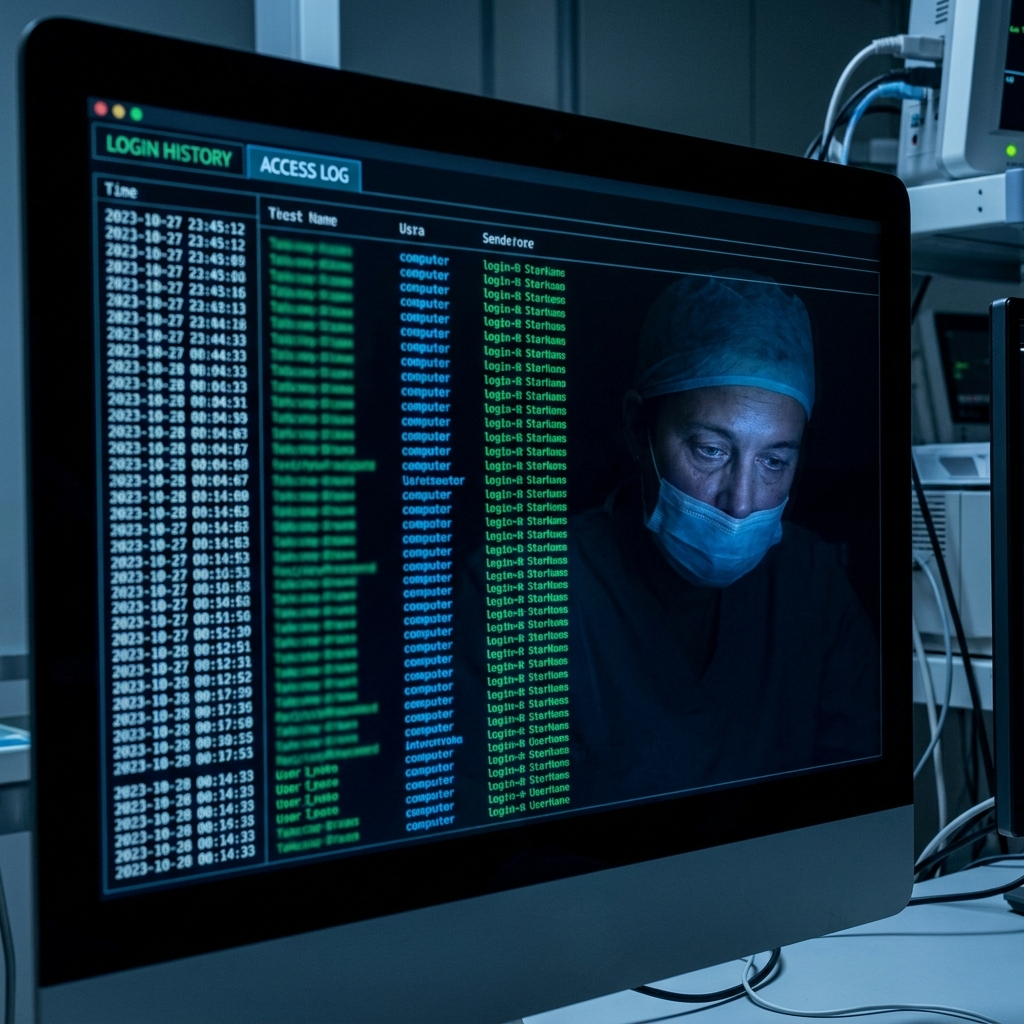
THE SYSTEM WAS TIMESTAMPING YOU THE WHOLE TIME
Here's the part almost no nurse knows. While you were charting from memory, the building was keeping its own record of you. Every badge scan. Every login. Every Pyxis pull, every barcode, every time you opened a chart and closed it. A parallel account of your shift, written automatically, that you never saw and never agreed to.
So your note says 08:00. The audit trail says 09:15. And nothing was wrong with what you did — you gave the med, you did the assessment, you were exactly where you were supposed to be. But now there are two records of the same shift that don't line up, and only one of them was written by a human being who was exhausted and behind. To be clear: charting late isn't falsification, and there's a proper way to mark a late entry so it's a documented fact instead of an open question. Almost nobody teaches it, so almost nobody uses it — and an unexplained gap is exactly the kind of thing an attorney gets to characterize their way.
That's the realization underneath all of it. The reconstructed note doesn't fail because you're dishonest. It fails because it's a summary standing where a witness should be — and the reasoning that made you good stayed back in the room. Two years later, a summary reads like a nurse who didn't think. That was true of every note, on every shift, all along. Most nurses were never taught otherwise, because nobody teaches defensive documentation. One legal nurse consultant set out to change that.
FINALLY UNDERSTOOD THE REAL ISSUE
Priya S.
Verified Buyer
"I had no idea the system was logging everything I did alongside what I wrote. Learning there's a right way to mark a late entry — and that I'd never been taught it in fifteen years — was genuinely alarming. I use it every single shift now."
4.
THE FIX WAS ALWAYS SMALL — NOBODY JUST SHOWED YOU
The reason it works when other resources don't: it's a way of reading your own notes, not a pile of tips. You learn to see one phrase the way a plaintiff's attorney will, then the next, and each fix quietly makes the one after it easier. You're never asked to chart more or stay later — just to write the same note a smarter way, so it stands on its own years from now.
A few of the first fixes:
Kill the phrase that hangs nurses — Swap "will continue to monitor" for a specific, documented action, so it can't be twisted into proof you saw a problem and did nothing.
Pair every quote with a fact — Follow a patient's words with an objective finding, so no lawyer can argue you wrote it to mock or dismiss them.
Prove you escalated — Document the call the moment you make it, so there's a record you notified the provider — not just your word two years later.
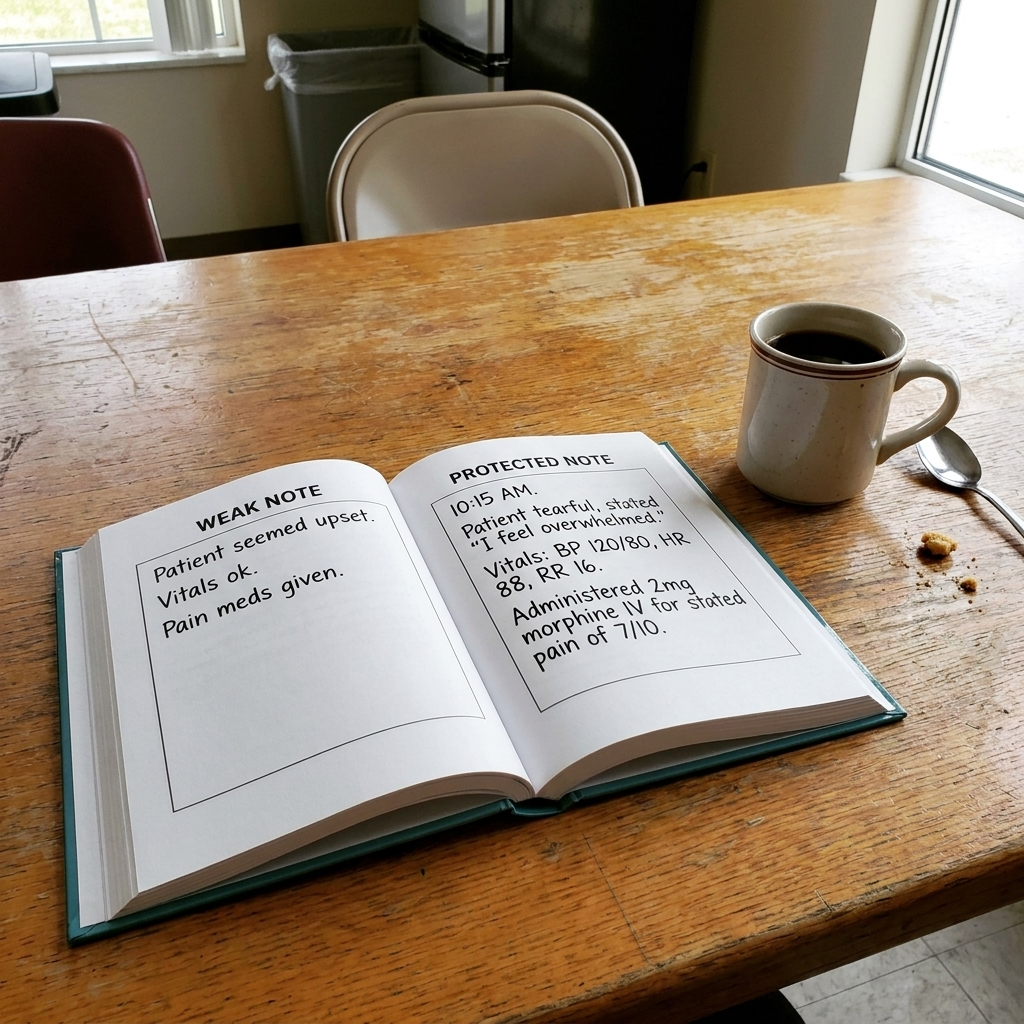
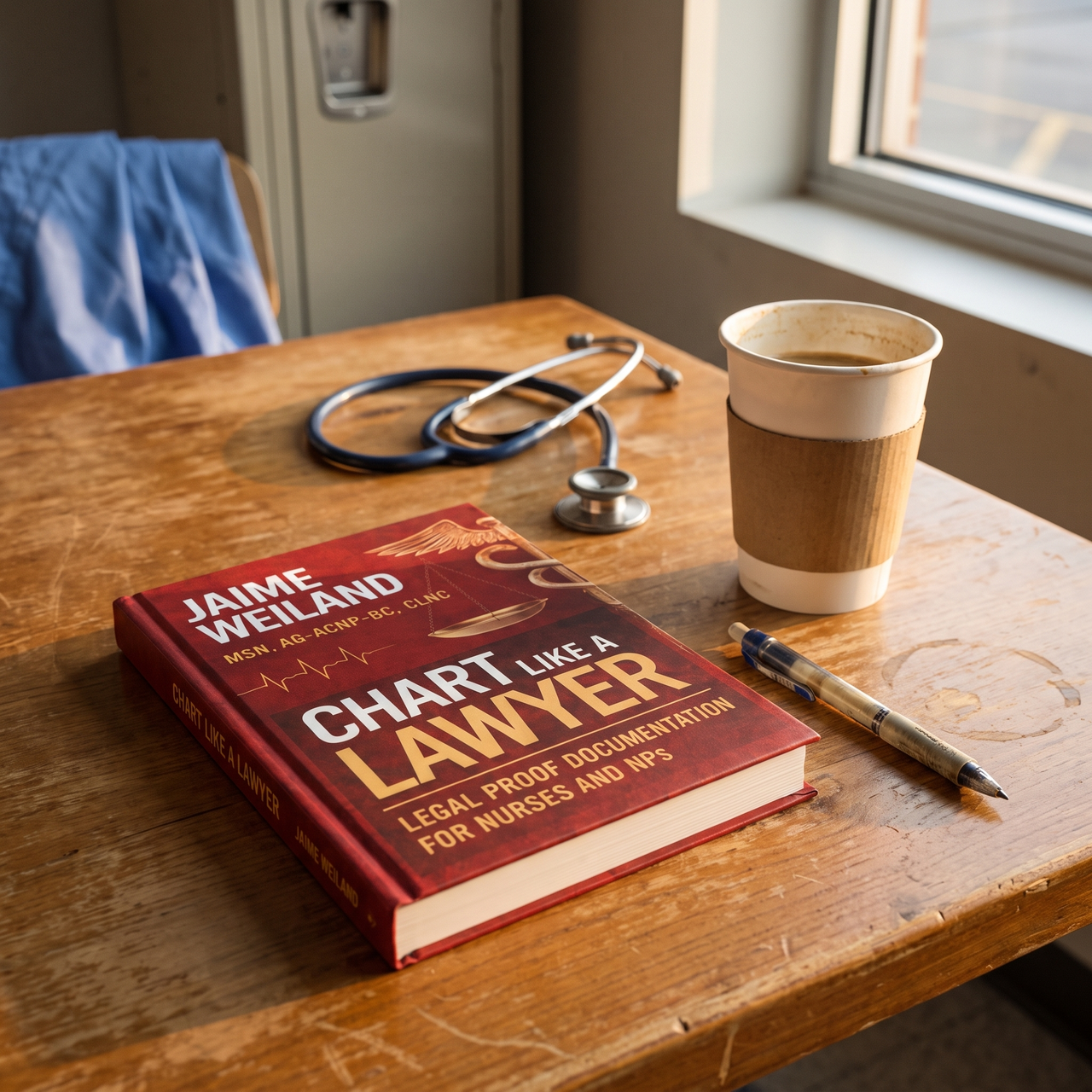
It was written by Jaime Weiland, a nurse practitioner who's lived your exact shift, and a legal nurse consultant whose job is reading charts the way the hospital's attorney reads them. It doesn't take time you don't have or details you can't recall. It works on any shift, at any ratio, because it's about how you write the note, not how much. Follow the examples — the weak note and the protected note, side by side — and you'll chart differently by your very next shift. And the whole book costs under forty dollars: less than one takeout dinner, with no course or subscription waiting at the end of it.
KNEW EXACTLY WHAT TO WRITE
Rebecca L.
Verified Buyer
"I expected another dry textbook. Instead it showed me the weak note next to the protected note, over and over. By my next shift I was already charting differently. The 'will continue to monitor' section alone was worth it."
5.
THE RISK WAS ALWAYS REAL. NOW YOU CAN CLOSE IT.
Picture the same shift — the same six patients, the same scrap of paper, the same 7:40 at the station. Nothing about the floor changes, because it isn't going to. But the note you write is different. The entry is marked. Your reasoning is on the page. Your calls are timestamped from the moment you made them. And two years from now, when someone pulls it cold, there's nothing to reconcile and nothing to explain — because the note already did both.
That's what nurses tell us again and again. Veterans with thirty years in say they wish they'd had it at the start. New grads say they finally feel like they know what they're doing. One nurse was removed from a lawsuit completely — pulled out of it — because of how she'd charted. Her words: what I charted is what happened. That was the entire defense.
For less than the price of a takeout dinner, you get the exact skill that turns a reconstructed note into a record that defends itself — and protects the license you spent years and thousands of dollars to earn. It's already sold out once because word spread so fast among nurses. And there's a guarantee: read it, and if it doesn't change how you chart, you're covered. The only real risk left is one more shift writing notes from memory that you'll be asked to defend as if you wrote them at the bedside. Tap below and grab your copy while it's in stock.
Karen M.
Verified Buyer
"I was named in a suit two years after caring for a patient I barely remembered. I pointed to my chart and repeated the same thing until they let me go. What I charted is what happened — and that's the only reason my name came off it. This book teaches you to chart exactly like that, before you ever need it."
THE HOSPITAL PROTECTS THE HOSPITAL. YOUR CHART PROTECTS YOU.
CHART LIKE A LAWYER
By Jaime Weiland — Legal-Proof Documentation for Nurses & NPs. Learn to chart so it protects you.
$59.99
Only $39.99




4.8 Stars — 10,000+ Verified Reviews