
5 REASONS WHY "JUST CHART EVERYTHING" IS THE WORST ADVICE A NEW NURSE EVER GETS
★★★★★
4.9 Stars — 11,000+ Verified Nurse Readers

1.
EVERY NEW NURSE GETS THE SAME ADVICE. ALMOST NO ONE QUESTIONS IT.
It's the first real charting wisdom anyone hands you. "When in doubt, chart everything." A preceptor says it, a charge nurse repeats it, and it gets passed down on every unit like gospel. And it sounds right — thorough, careful, responsible. Exactly what a good new nurse should do.
So you take it to heart. You write down everything you can think of, because the alternative — missing something — is the thing you're most afraid of. More feels like more protection. It feels like covering yourself. And nobody around you is saying any different, so why would you stop to question it?
Here's the thing almost no one tells you: the advice feels responsible, and that's exactly why it's so dangerous. It never gets examined. Everyone assumes that writing more must be safer, and that assumption gets handed to every new nurse before anyone checks whether it's actually true. It isn't — and the gap between how safe it feels and how safe it is can cost you.
I HEARD IT ON DAY ONE
Teresa K.
Verified Buyer
"'When in doubt, chart everything.' Every single person told me that when I started. It never once occurred to me that it might be bad advice until I read this. It genuinely reframed how I think about every note."
2.
WRITING EVERYTHING ISN'T THOROUGH. IT'S A BIGGER TARGET.
Here's what nobody warns you about when they tell you to chart it all. The longer and more detailed a note is, the more surface area it gives someone looking to pick it apart. Every extra sentence is another chance for two details to contradict each other. Every added observation is another thing you can be questioned on, line by line, two years later.
A plaintiff's attorney doesn't fear the long note — they love it. It's where the openings live. An inconsistency between what you wrote at 2 p.m. and what you wrote at 8 p.m. An offhand detail that reads badly out of context. An admission you didn't even realize you were making. The exhaustive note you wrote to protect yourself is the one that hands them the most to work with.
That's the cruel twist of "chart everything." It doesn't just fail to protect you — it actively increases your exposure. Volume isn't a shield. It's a bigger target. And the nurse who was told to cover herself by writing more has, without knowing it, been writing herself into a corner since her very first shift.
MORE WAS NEVER SAFER
Denise H.
Verified Buyer
"I always thought a longer note meant a safer note. This showed me exactly how a lawyer uses all that extra detail against you. I felt a little sick realizing I'd been making myself more exposed, not less, all this time."
3.
THE NURSES WHO GET THIS EARLY STOP CHARTING TO COVER, AND START CHARTING TO PROTECT
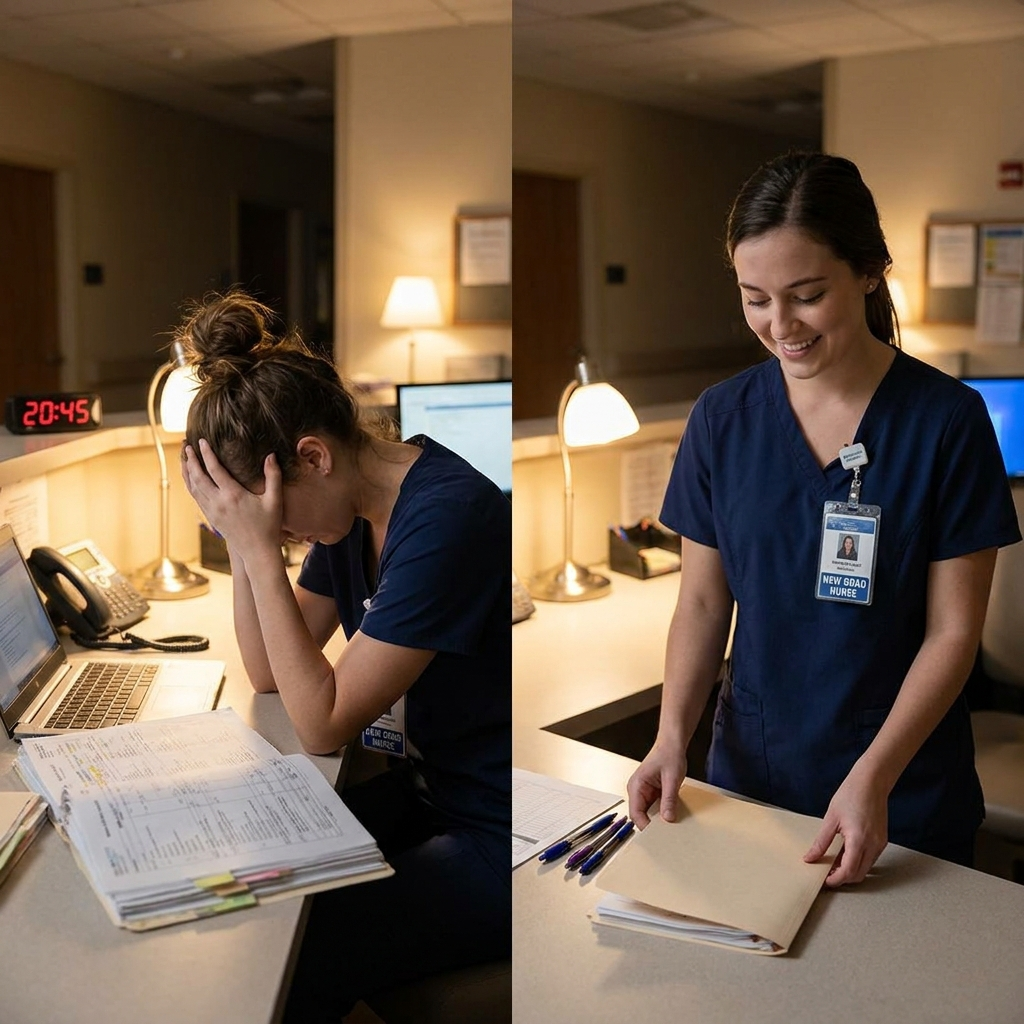
Now picture two nurses who started the same week. Same orientation, same units, same fear of missing something. One is still writing everything down, exhausted, hoping volume keeps her safe. The other learned early which few things actually carry the legal weight — and stopped spending herself on all the rest.
Here's the pivot almost no one understands until someone finally shows them. The protected nurse isn't more experienced, and she doesn't care more about her patients. She just chart to protect instead of charting to cover. A tight, specific, defensible note holds up in a way a sprawling one never can — and it takes a fraction of the time to write. She's not doing less because she's lazy. She's doing less because she knows exactly where to aim.
That's the whole difference between the two of them, and it has almost nothing to do with skill at the bedside. Your instinct, your judgment, the care you gave — none of it protects you if the note buries it in noise or hands an attorney an opening. The chart is the only version of you that lasts. It either defends you or exposes you. Most new nurses were never taught which, because nobody teaches defensive documentation. One legal nurse consultant set out to change that.
FINALLY UNDERSTOOD THE REAL ISSUE
Priya S.
Verified Buyer
"I assumed charting well just meant charting more. This flipped it completely — write the few things that matter, protect yourself, and go home. I wish someone had taught me this in my first week instead of 'just write everything.'"
4.
THERE'S A WAY TO WRITE SO THE CHART DEFENDS YOU FOR YOU
The reason it works when other resources don't: it's a way of reading your own notes, not a pile of tips. You learn to see one phrase the way a plaintiff's attorney will, then the next, and each fix quietly makes the one after it easier. You're never asked to chart more or stay later — just to write the same note a smarter way, so it stands on its own years from now.
A few of the first fixes:
Kill the phrase that hangs nurses — Swap "will continue to monitor" for a specific, documented action, so it can't be twisted into proof you saw a problem and did nothing.
Pair every quote with a fact — Follow a patient's words with an objective finding, so no lawyer can argue you wrote it to mock or dismiss them.
Prove you escalated — Document the call the moment you make it, so there's a record you notified the provider — not just your word two years later.
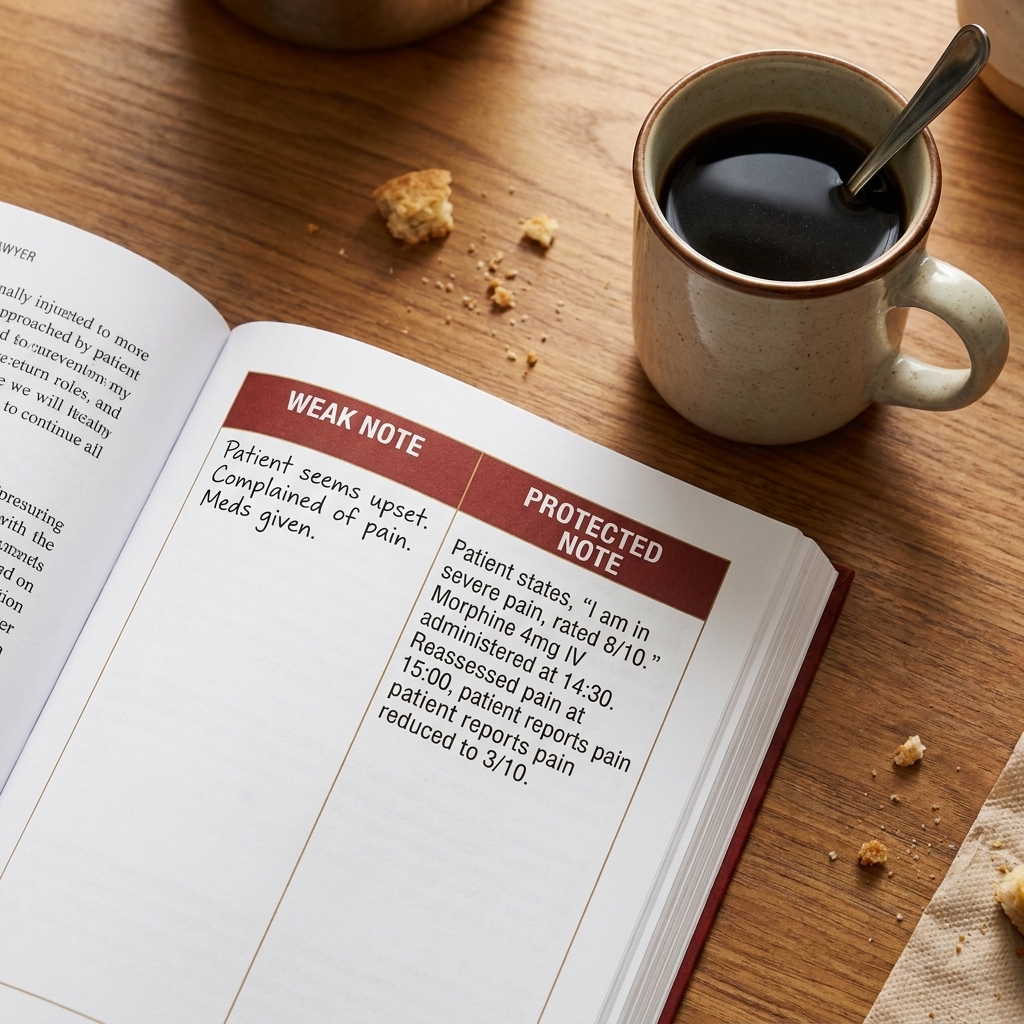
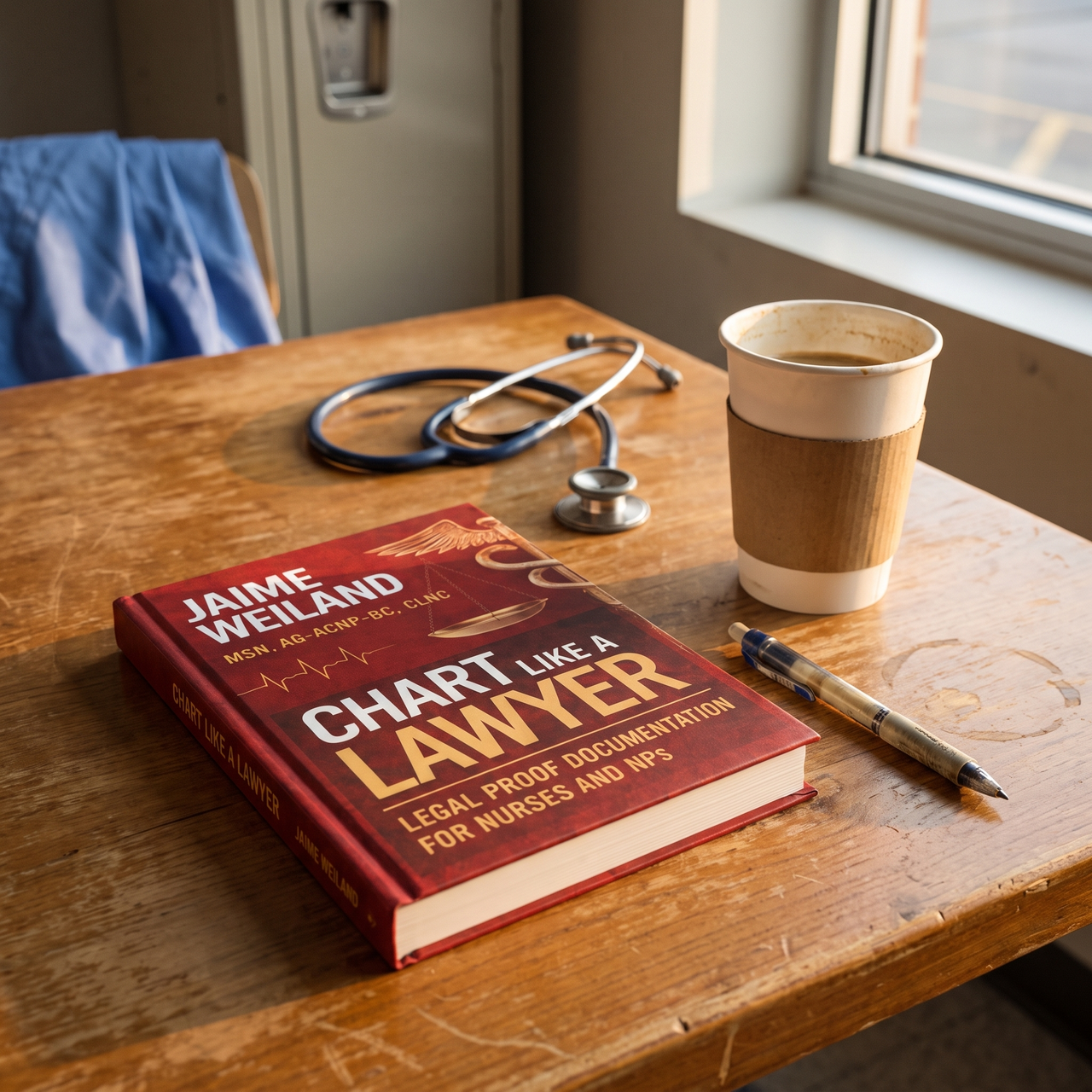
It was written by Jaime Weiland, a nurse practitioner who's lived your exact shift, and a legal nurse consultant whose job is reading charts the way the hospital's attorney reads them. It doesn't take time you don't have or details you can't recall. It works on any shift, at any ratio, because it's about how you write the note, not how much. Follow the examples — the weak note and the protected note, side by side — and you'll chart differently by your very next shift. And the whole book costs under forty dollars: less than one takeout dinner, with no course or subscription waiting at the end of it.
KNEW EXACTLY WHAT TO WRITE
Rebecca L.
Verified Buyer
"I expected another dry textbook. Instead it showed me the weak note next to the protected note, over and over. By my next shift I was already charting differently. The 'will continue to monitor' section alone was worth it."
5.
IMAGINE CHARTING WITH CONFIDENCE INSTEAD OF FEAR
Picture your next shift ending — and you closing the chart knowing it's tight, complete, and holds up, instead of second-guessing every line. No hour-long tail after everyone's gone home. No wall of text you wrote out of fear. No lying awake wondering if you wrote too much, too little, or the wrong thing. Just the right note, done right, and the quiet confidence that you're covered.
That's what nurses tell us again and again. New grads say they finally feel like they know what they're doing. Veterans with thirty years in say they wish they'd had it at the start. One nurse was removed from a lawsuit completely — pulled out of it — because of how she'd charted. Her words: what I charted is what happened. Tight, specific, and enough.
For less than the price of a takeout dinner, you get the exact skill nursing school never taught you — the one that protects the license you spent years and thousands of dollars to earn, from your very first year instead of learning it the hard way. It's already sold out once because word spread so fast among nurses. And there's a guarantee: read it, and if it doesn't change how you chart, you're covered. The only real risk left is building the "chart everything" habit for another shift. Tap below and grab your copy while it's in stock.
Karen M.
Verified Buyer
"Starting out, I was terrified of my charting and it showed — my notes were a mile long and I still felt exposed. This taught me what actually matters and I finally chart with confidence. I wish every new grad got handed this on day one."
THE HOSPITAL PROTECTS THE HOSPITAL. YOUR CHART PROTECTS YOU.
CHART LIKE A LAWYER
By Jaime Weiland — Legal-Proof Documentation for Nurses & NPs. Learn to chart so it protects you.
$59.99
Only $39.99




4.8 Stars — 10,000+ Verified Reviews