
5 REASONS WHY THE KNOT IN YOUR STOMACH BEFORE EVERY SHIFT ISN'T ABOUT THE WORKLOAD — IT'S ABOUT WHAT YOU CAN'T PROVE
★★★★★
4.9 Stars — 11,000+ Verified Nurse Readers
1.
YOU FEEL IT IN THE PARKING LOT BEFORE YOU EVEN CLOCK IN
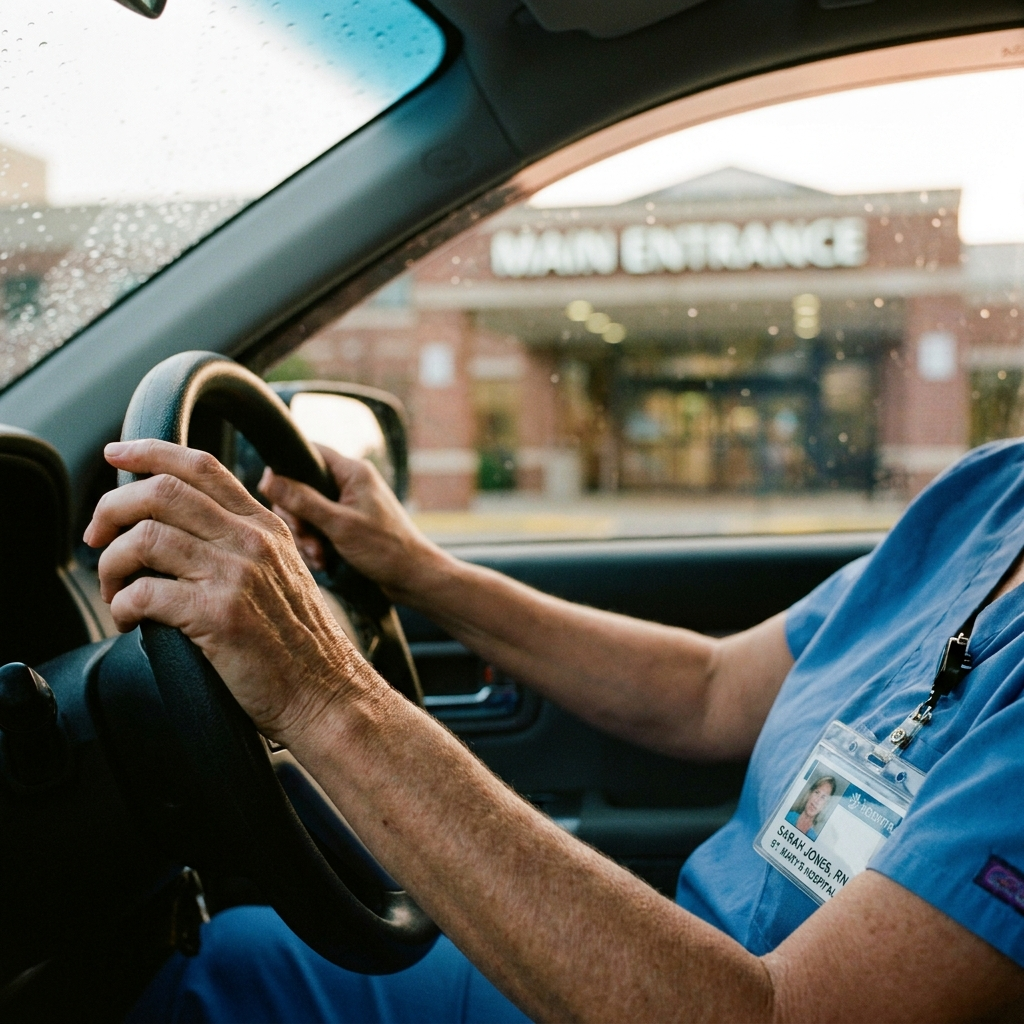
That tightening under the ribs. You're in your car, engine off, and instead of getting out you sit there for a minute. Maybe two. The shift hasn't even started and something in you is already braced for it. You breathe through it, grab your badge, and go up anyway — because that's what you do.
You tell yourself it's just the day ahead. The load. The pace. The knowledge that there won't be enough of you to go around, again. And that's real — the work is hard and the staffing is worse. So of course that's where you assume the feeling comes from.
But here's the thing you may have never stopped to notice: the busiest shifts don't always leave the knot, and some perfectly ordinary ones do. If it were purely about workload, the dread would track the chaos. It doesn't. Which means the feeling is pointing at something else — something quieter, and more specific — and once you see what it actually is, you can do something about it.
I SIT IN MY CAR EVERY MORNING
Teresa K.

Verified Buyer
"I genuinely thought I was the only one who sat in the parking lot bracing myself before a shift. Reading this named a feeling I'd had for years and never understood. It turned out not to be what I assumed at all."

2.
IT'S NOT THE WORK YOU'RE BRACING FOR. IT'S THE EXPOSURE.
Think about what the knot is actually made of. It isn't the twelve hours of tasks in front of you — you know how to do the tasks, you've done them a thousand times. It's the quiet what-if running underneath them. What if today is the shift that comes back on me. What if something goes sideways and the note doesn't hold.
You've probably never named it that plainly, because who has the time. But that's the thing your stomach is bracing against — not the work you might not finish, but the record you might not be able to stand behind. And those are two completely different fears. An unfinished task, you can catch up on. An undocumented judgment call, a vague note, a conversation that lived only out loud — those you can't get back once the shift is over.
That's why the feeling is so specific and so stubborn. It isn't general overwhelm. It's your instinct doing math you're not consciously aware of: weighing what could happen against what your chart could actually prove, and coming up uncertain. It isn't fragility and it isn't burnout in that moment. It's the most experienced part of you, flagging a gap before you've even walked onto the floor.
IT WAS THE EXPOSURE, NOT THE HOURS
Denise H.
Verified Buyer
"I always chalked the dread up to being tired and overworked. This helped me see it was really about whether I could back up what I did if it ever came to it. Naming that changed the whole feeling for me."
3.
BUT HERE'S WHAT CHANGES EVERYTHING
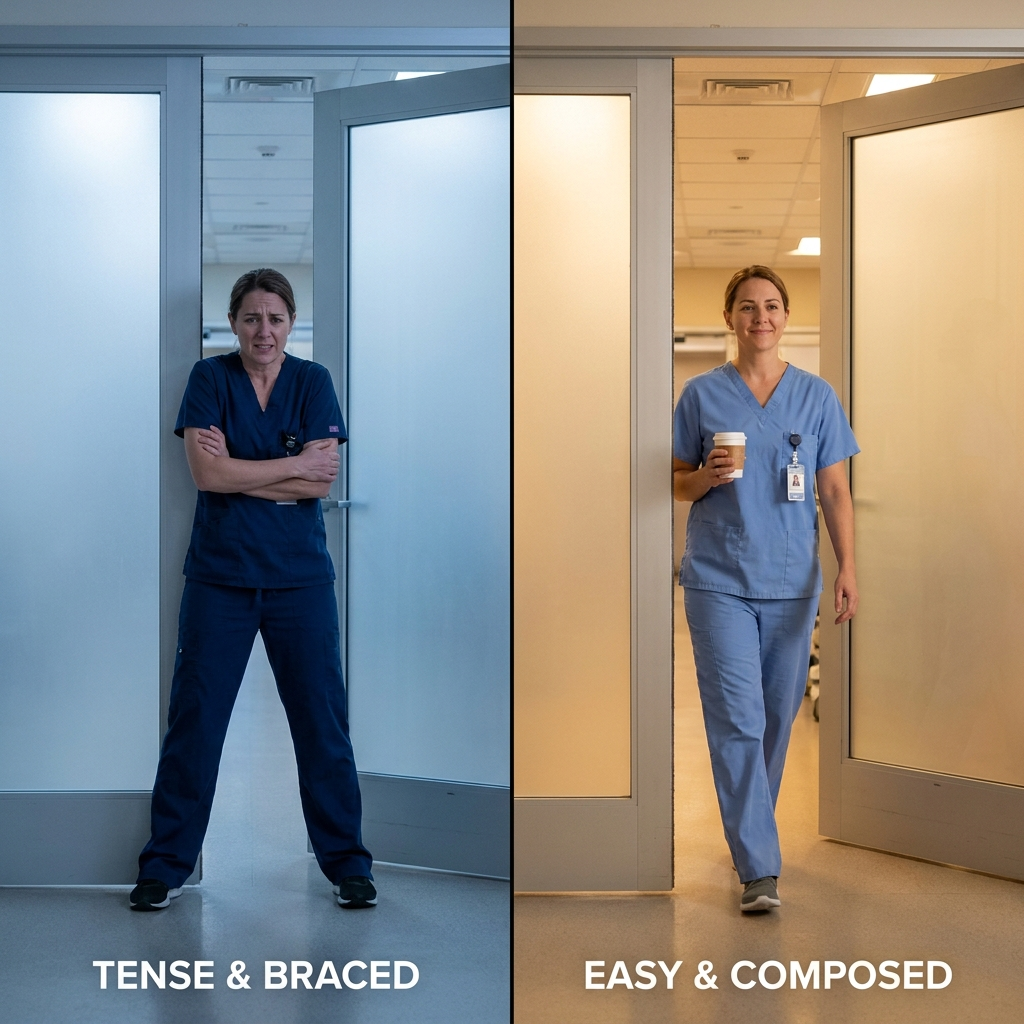
Now picture the nurse who walks in without the knot. Same floor, same ratios, same impossible assignment. She isn't carrying a lighter load and she isn't tougher than you. The difference is that she's carrying a chart she trusts — so the what-if that tightens your stomach has nothing to grab onto in hers.
Here's the pivot almost no one understands until someone shows them. When you know your notes will hold no matter how the shift breaks, the dread loses its grip. Not because you've talked yourself out of it, but because the thing it was warning you about is handled. The knot was never really about the work. It was about the doubt — and doubt is fixable in a way understaffing never will be.
That's the whole difference between the two of you, and it has almost nothing to do with how much you can handle. Toughness was never the variable — if it were, the most conscientious nurses would dread the least, and you know it runs exactly the other way. The variable is whether your chart can stand behind you without you there to explain it. Most nurses were never taught to write one that can, because nobody teaches defensive documentation. One legal nurse consultant set out to change that.
FINALLY UNDERSTOOD THE REAL ISSUE
Priya S.
Verified Buyer
"I assumed the calm nurses just handled stress better than me. This showed me it wasn't about handling stress at all — their charting held, so they had nothing to brace against. It completely reframed the problem."
4.
THERE'S A WAY TO WRITE SO THERE'S NOTHING LEFT TO BRACE FOR
The reason it works when other resources don't: it's a way of reading your own notes, not a pile of tips. You learn to see one phrase the way a plaintiff's attorney will, then the next, and each fix quietly makes the one after it easier. You're never asked to chart more or stay later — just to write the same note a smarter way, so it stands on its own years from now.
A few of the first fixes:
Kill the phrase that hangs nurses — Swap "will continue to monitor" for a specific, documented action, so it can't be twisted into proof you saw a problem and did nothing.
Pair every quote with a fact — Follow a patient's words with an objective finding, so no lawyer can argue you wrote it to mock or dismiss them.
Prove you escalated — Document the call the moment you make it, so there's a record you notified the provider — not just your word two years later.
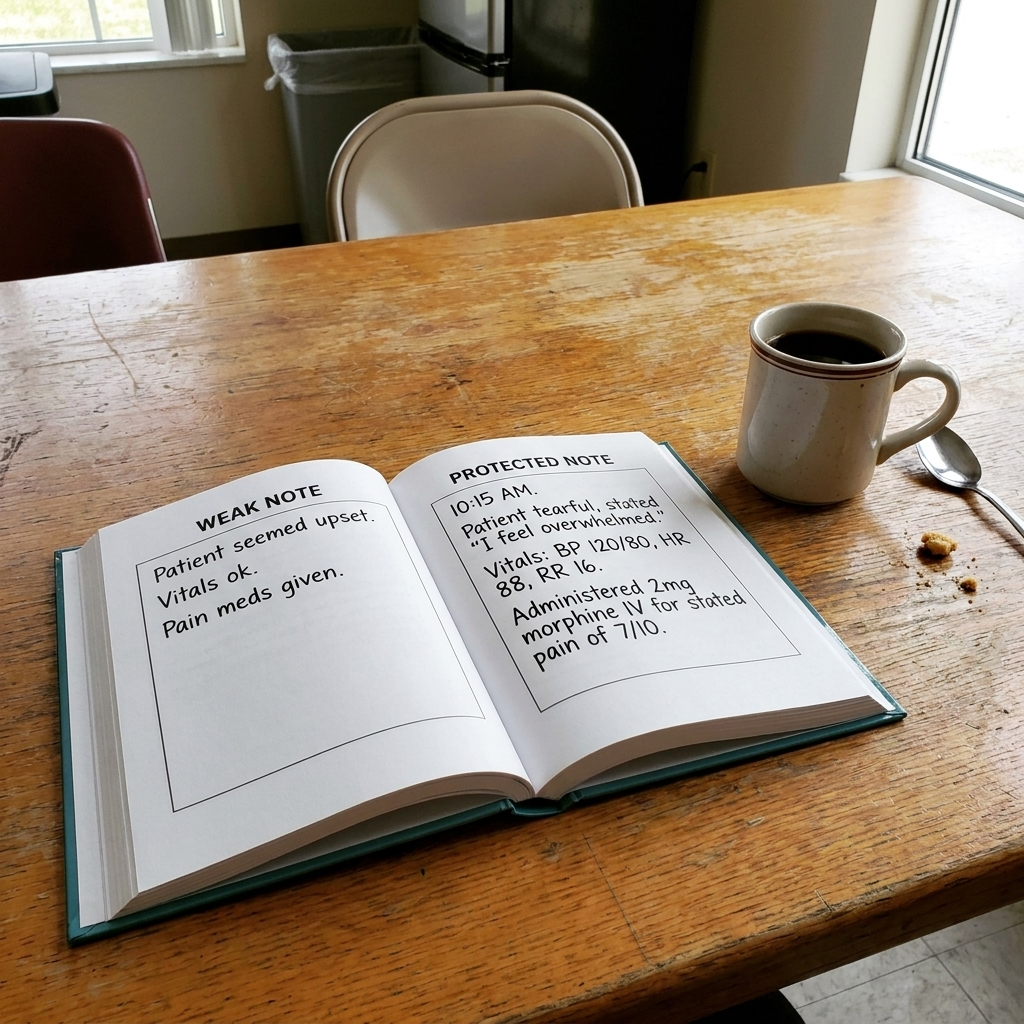
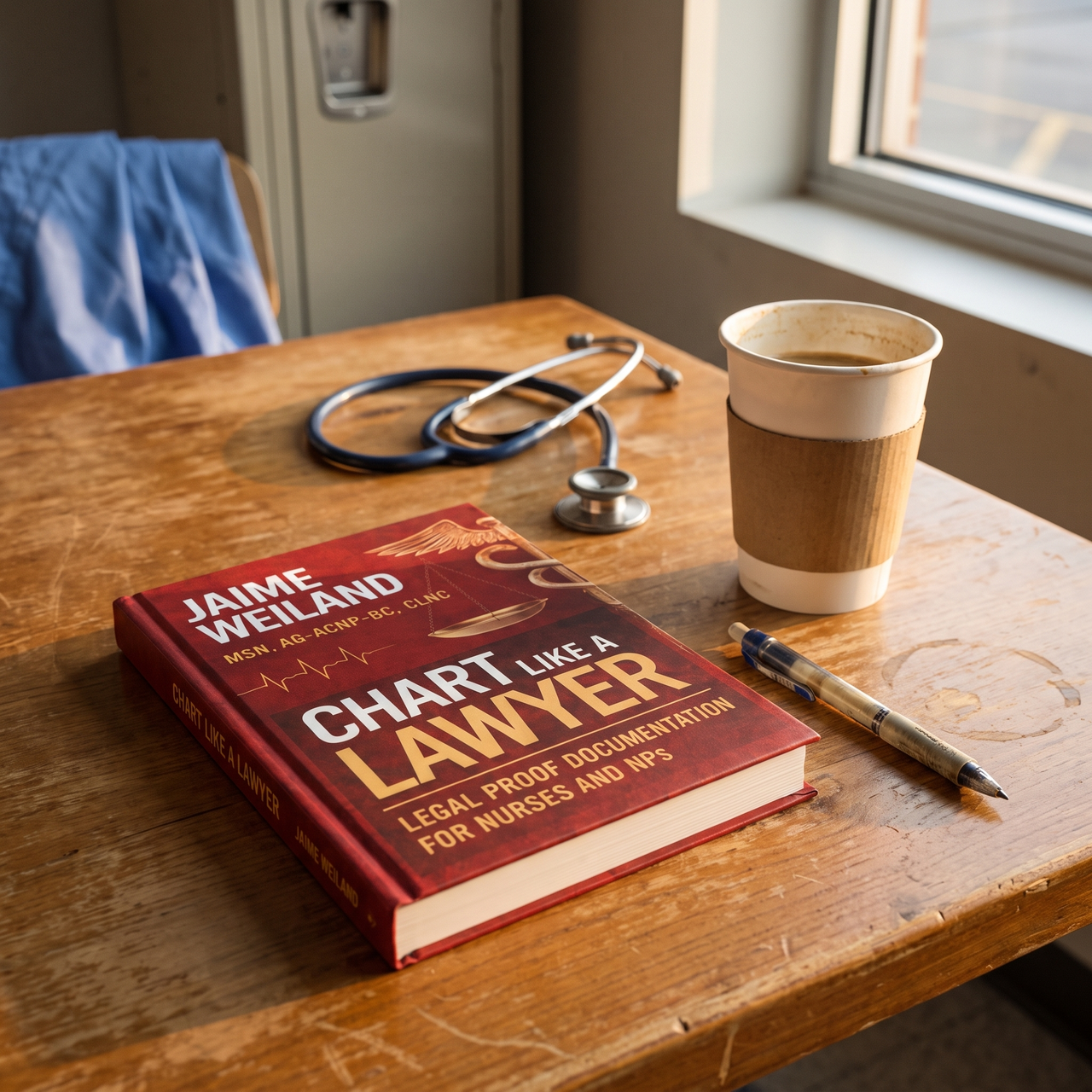
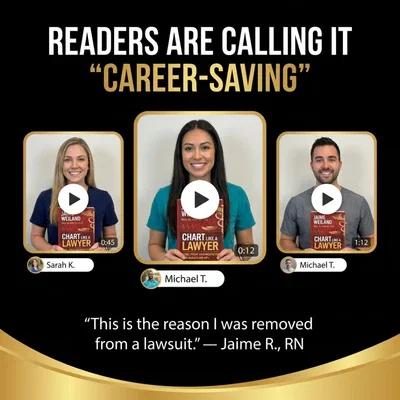
It was written by Jaime Weiland, a nurse practitioner who's lived your exact shift, and a legal nurse consultant whose job is reading charts the way the hospital's attorney reads them. It doesn't take time you don't have or details you can't recall. It works on any shift, at any ratio, because it's about how you write the note, not how much. Follow the examples — the weak note and the protected note, side by side — and you'll chart differently by your very next shift. And the whole book costs under forty dollars: less than one takeout dinner, with no course or subscription waiting at the end of it.
KNEW EXACTLY WHAT TO WRITE
Rebecca L.
Verified Buyer
"I expected another dry textbook. Instead it showed me the weak note next to the protected note, over and over. By my next shift I was already charting differently. The 'will continue to monitor' section alone was worth it."
5.
IMAGINE WALKING IN STEADY FOR ONCE
Picture pulling into that same lot before your next shift. Same floor, same ratios, same impossible day waiting upstairs. But this time you don't sit in the car. There's no knot, because whatever the day throws at you, you already know your chart will say what happened. You walk in and do the work you're great at — without the what-if riding along underneath every hour of it.
That's what nurses tell us again and again. Veterans with thirty years in say they wish they'd had it at the start. New grads say they finally feel like they know what they're doing. One nurse was removed from a lawsuit completely — pulled out of it — because of how she'd charted. Her words: what I charted is what happened. That was the entire defense.
For less than the price of a takeout dinner, you get the exact skill that takes the knot out of your mornings — and protects the license you spent years and thousands of dollars to earn. It's already sold out once because word spread so fast among nurses. And there's a guarantee: read it, and if it doesn't change how you chart, you're covered. The only real risk left is bracing through one more shift over a gap a single line on the page could have closed. Tap below and grab your copy while it's in stock.
Karen M.
Verified Buyer
"I used to sit in my car dreading every shift, and I thought that was just nursing now. Once my charting actually held up, that pit in my stomach faded. Same hard job — but I walk in steady. That alone was worth far more than the price."
THE HOSPITAL PROTECTS THE HOSPITAL. YOUR CHART PROTECTS YOU.
CHART LIKE A LAWYER
By Jaime Weiland — Legal-Proof Documentation for Nurses & NPs. Learn to chart so it protects you.
$59.99
Only $39.99




4.8 Stars — 10,000+ Verified Reviews